
Currently Empty: ₹0.00

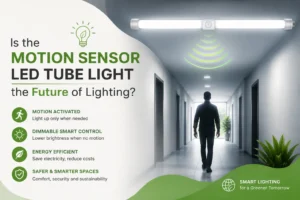
Yes, motion sensor LED tube lights are the undisputed future of energy-efficient illumination. By merging high-durability LED technology with intelligent motion-sensing and dimmable standby controls, these smart fixtures eliminate the massive waste of traditional manual switches. They slash electricity bills, drastically reduce carbon dioxide (CO₂) emissions, and lower facility maintenance costs, making them the ultimate eco-friendly lighting solution for both residential and commercial spaces.
What is a Motion Sensor LED Tube Light?
A motion sensor LED tube light is an intelligent, integrated lighting fixture designed to replace traditional, inefficient fluorescent tubes. Unlike static lights that remain at 100% brightness regardless of room occupancy, these smart fixtures integrate advanced sensors directly inside or adjacent to the housing.
By continuously monitoring their surroundings, these tubes automatically switch on or scale their brightness in response to human presence. The integration of dimmable brightness control technology allows these lights to transition seamlessly between high-intensity operational mode and a low-energy standby state, creating a flexible and automated lighting environment.
Why Use Movement Sensors in Lighting?
For decades, manual wall switches have been the standard method for controlling lights. While acceptable in single-family homes, manual control is highly inefficient in larger commercial properties, multi-family residential complexes, and public infrastructure.
Without automation, lights in unoccupied zones are frequently left burning 24/7, resulting in:
- Massive Energy Waste: Drawing electricity when there is zero demand.
- Accelerated Wear and Tear: Shortening the operational lifespan of light fixtures.
- Inflated Maintenance Budgets: Requiring frequent bulb replacements and labor costs.
Implementing movement sensors ensures that illumination is provided exactly when and where it is needed. Furthermore, with the industry-wide transition to solid-state LED technology, sensor-driven controls have become incredibly durable. Unlike legacy fluorescent lights, modern LEDs are completely unaffected by frequent on-and-off switching cycles, making them the perfect companion for motion detection systems.
How it Works: The Science of Motion Detection
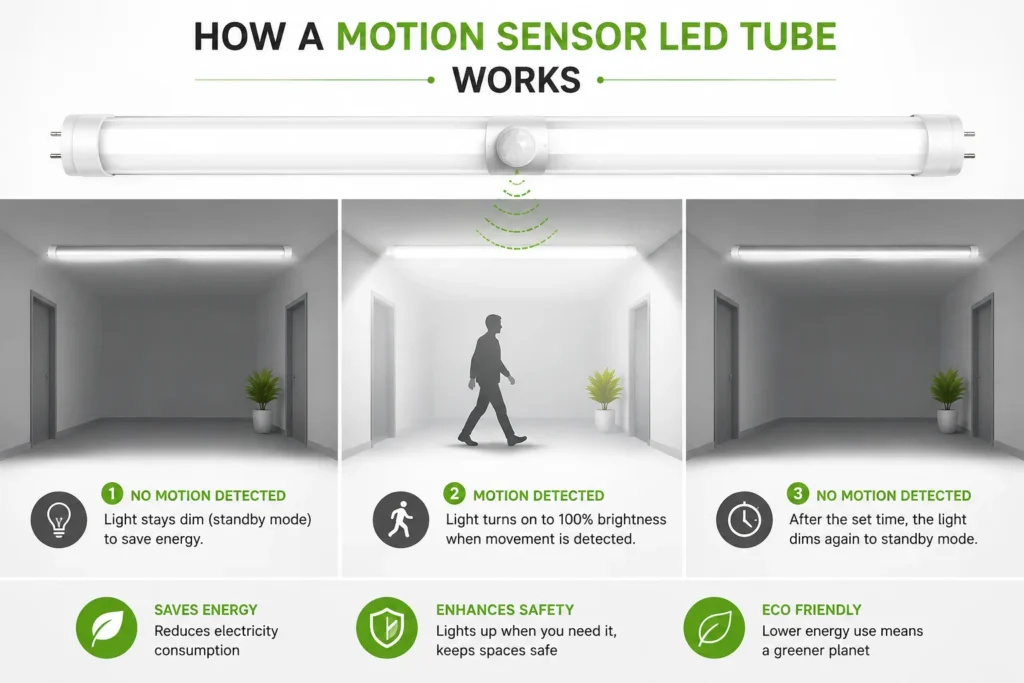
Modern motion-activated lights rely on highly sophisticated electronic detection systems. The underlying principle is simple yet powerful: detect physical movement or thermal shifts in a designated area and translate that disruption into an electrical command to trigger the light.
To understand how these “luminous sentinels” operate, we must look at the primary technologies that dominate the market, alongside advanced hybrid solutions.
Core Sensor Technologies
Passive Infrared (PIR) Sensors: The Thermal Listener
The most widespread motion detection technology is the Passive Infrared (PIR) sensor. The defining feature of this technology is right in its name—it is entirely passive.
The motion detector emits no waves; it simply listens to the thermal signature of its environment.
Every warm body, whether human or animal, naturally emits infrared radiation. A PIR sensor contains a pyroelectric component positioned behind a segmented Fresnel lens. This specialized lens focuses incoming infrared light onto the sensor. When a person moves across the detection zone, the thermal gradient changes rapidly. It is this sudden change in temperature—and not the static heat of the room—that the pyroelectric component transforms into an electrical trigger signal.
PIR Strengths: Highly energy-efficient, budget-friendly, and perfect for localized or directional zones.
PIR Limitations: Can be under-sensitive in hot climates where ambient temperatures match body heat, or over-sensitive in very cold environments. They are also less effective when a person walks directly toward the sensor, requiring cross-motion for optimal detection.
Microwave Sensors: The Echo Analyzer
Microwave sensors represent an active form of motion detection. Instead of listening, these devices continuously emit low-power, high-frequency electromagnetic waves, typically around 24 GHz.
The sensor then measures the “echo time”—the exact duration it takes for the wave to bounce off surrounding objects and return to the receiver. When any matter moves within the coverage zone, the disruption in the microwave beam alters the echo time. This change, analyzed via the Doppler effect, instantly triggers the LED tube.
Microwave Strengths: Completely unaffected by ambient temperature variations, dust, or wind. They are highly sensitive, respond to minor movements, and can even detect motion through thin partitions such as plasterboard walls. They can also be integrated directly inside the light fixture for a clean aesthetic.
Microwave Limitations: Highly sensitive, meaning they can sometimes be triggered by non-human movements, such as a tree branch blowing outside a window.
Dual-Technology Sensors: The Precision Alliance
To eliminate false alarms, manufacturers utilize dual-technology sensors. These advanced units combine both a PIR and a microwave sensor within a single housing.
The system employs mutual verification: the LED tube will only activate if both sensors detect motion simultaneously. A warm draft of wind might trigger the PIR sensor, but the microwave radar will see no movement. Conversely, a fluttering window blind might trip the microwave sensor, but without a thermal signature, the PIR sensor remains silent. By utilizing digital signal processors to coordinate these sensors, dual-tech systems offer exceptional immunity to environmental interference.
Thermal Sensors: The Next Frontier
The future of motion sensing lies in low-resolution thermal imaging sensors. As manufacturing costs decrease, these sensors are transitioning from industrial environments into mainstream commercial lighting.
Thermal sensors capture actual heat maps of the environment, allowing them to:
- Identify objects based on their shape, distinguishing a human from a pet or a cart.
- Track the exact direction of movement.
- Achieve true “presence detection,” remaining on even if a person is sitting completely still.
- Count the number of occupants to optimize ventilation and energy usage.
Dimmable Brightness Control: Beyond On and Off
Traditional sensor lighting was binary: either 100% on or completely off. While effective for energy savings, this on/off cycle can be jarring and raise safety concerns in public spaces like parking garages or dark corridors.
Dimmable brightness control technology completely solves this problem. Instead of plunging a room into total darkness, the LED tube gently dims down to a low-light standby level, such as 10% to 20% brightness, when no occupancy is detected.
This standby illumination ensures that:
- Spaces never feel pitch black, maintaining a sense of safety and comfort.
- The fixture uses a mere fraction of its full power while in standby mode.
- When a sensor is triggered, the light smoothly ramps back up to 100% capacity.
How It Becomes the Future: Low-Usage Area Optimization
In any building, there are extensive zones classified as “low-usage” or transitional areas. Under traditional configurations, these areas are fitted with standard, always-bright tubes that burn electricity endlessly.
Consider these prime examples where constant 100% brightness is highly wasteful:
Fire Stairs and Emergency Exit Stairwells
Fire stairs are a critical safety requirement in commercial buildings, yet they are occupied for only a small portion of the day. Keeping high-output tubes fully illuminated 24 hours a day in an empty stairwell is incredibly inefficient.
An integrated microwave motion sensor LED tube solves this by keeping the stairs at a safe, low-dimmed level, instantly lighting up the pathway ahead of an occupant before they step onto the landing.
Commercial and Residential Parking Garages
Car parks experience massive fluctuations in traffic. Outside of peak commuting hours, activity is sparse. Standalone motion sensors in car parks often struggle with blind spots, causing lights to stay on too long or turn off on drivers sitting in their vehicles.
By switching to integrated motion-activated dimmable LED tubes, each fixture acts as its own intelligent node. As a car or pedestrian moves through the garage, only the immediate path is illuminated to full brightness, while the rest of the facility remains in a safe, low-power dimmed state.
Unrivaled Energy Efficiency and Eco-Friendliness
The pairing of modern LED technology with intelligent controls delivers a massive reduction in energy waste.
| Lighting Feature | Impact on Energy & Sustainability |
|---|---|
| Low Power Consumption | LEDs natively draw significantly less wattage than fluorescent tubes. |
| Motion-Driven Shutdown | Eliminates idle energy waste when areas are completely vacant. |
| Dimmable Standby | Drastically reduces energy usage during low-traffic periods. |
| Extended Lifespan | LEDs are highly durable and run cool, and reducing their high-output run-time extends their operational life even further. |
| CO₂ Reduction | Slashing electricity consumption directly translates to lower carbon emissions from power grids. |
By implementing these smart fixtures, building operators can expect a rapid financial return on investment (ROI) through reduced utility bills and lower ongoing maintenance requirements.
Best Places for Installation
Due to their incredible versatility, motion sensor LED tubes are highly recommended for a diverse range of residential, commercial, and industrial settings.
Commercial Spaces: Corporate offices, hallways, conference rooms, and public corridors.
Residential Areas: Apartment complexes, interior staircases, garages, closets, pantries, and kitchen worktops.
Industrial & Public Facilities: Warehouses, hospitals, educational institutions, retail stores, and emergency exit pathways.
Customizing Your Setup: Crucial Settings to Adjust
To ensure your smart motion-activated lighting system functions flawlessly without causing user frustration, three fundamental parameters must be properly calibrated.
Sensitivity Settings
Adjusts the detection range and threshold. Setting this too high can cause the light to turn on from moving tree branches or drafts, while too low will leave people in the dark. Range can vary from close-range detection for closets up to long-range detection for large properties.
Timer/Delay Settings
Determines how long the light remains at full output after the last detected movement. A short delay of 15 to 30 seconds is perfect for transitional hallways or staircases, whereas a garage or entryway benefits from 1 to 3 minutes.
Ambient Light (Lux) Threshold
Establishes the level of natural daylight below which the sensor is permitted to activate. This day/night distinction prevents the light from turning on in direct, bright sunlight.
For lights installed in hard-to-reach locations above 4 meters, opting for fixtures with remote-control adjustments is ideal, removing the need for specialized lift equipment.
Conclusion: Step Into the Smarter Light
The evidence is clear: the manual wall switch is becoming outdated. Motion-activated and dimmable LED tube lights represent the next generation of lighting technology. By providing illumination only when needed and scaling down energy draw during low-traffic periods, these smart fixtures offer a seamless, user-friendly experience that actively protects our planet and saves money.
Making the upgrade to motion sensor lighting isn’t just a high-tech trend—it is a vital step toward building a smarter, greener, and more sustainable future.